
The hedge trimmer market today covers three main power families (corded, battery, gas) and price ranges that vary in a ratio of 1 to 20 according to Que Choisir. In light of this offering, the choice of a hedge trimmer relies less on the brand than on the specific nature of the hedge to be maintained, the terrain configuration, and local regulatory constraints.
Tooth spacing and cutting diameter: the often overlooked technical criterion
Most guides first compare the engines. However, the spacing of the blade teeth deserves to be examined first, as it determines the maximum diameter of branches that the machine can neatly shear.
A reduced spacing is suitable for young hedges, boxwoods, or topiaries whose branches remain thin. A wider spacing is necessary as the hedge ages and produces hard wood. Using an undersized hedge trimmer on branches that are too thick damages the blades, strains the motor, and leaves ragged cuts that weaken the plant against diseases.
Before any purchase, measure the diameter of the thickest branches in your hedge. If they exceed the advertised cutting capacity, a lopper or a pruner will be necessary as a supplement. Detailed sheets are available on taille-haie-warrior.com to compare cutting capacities by model.
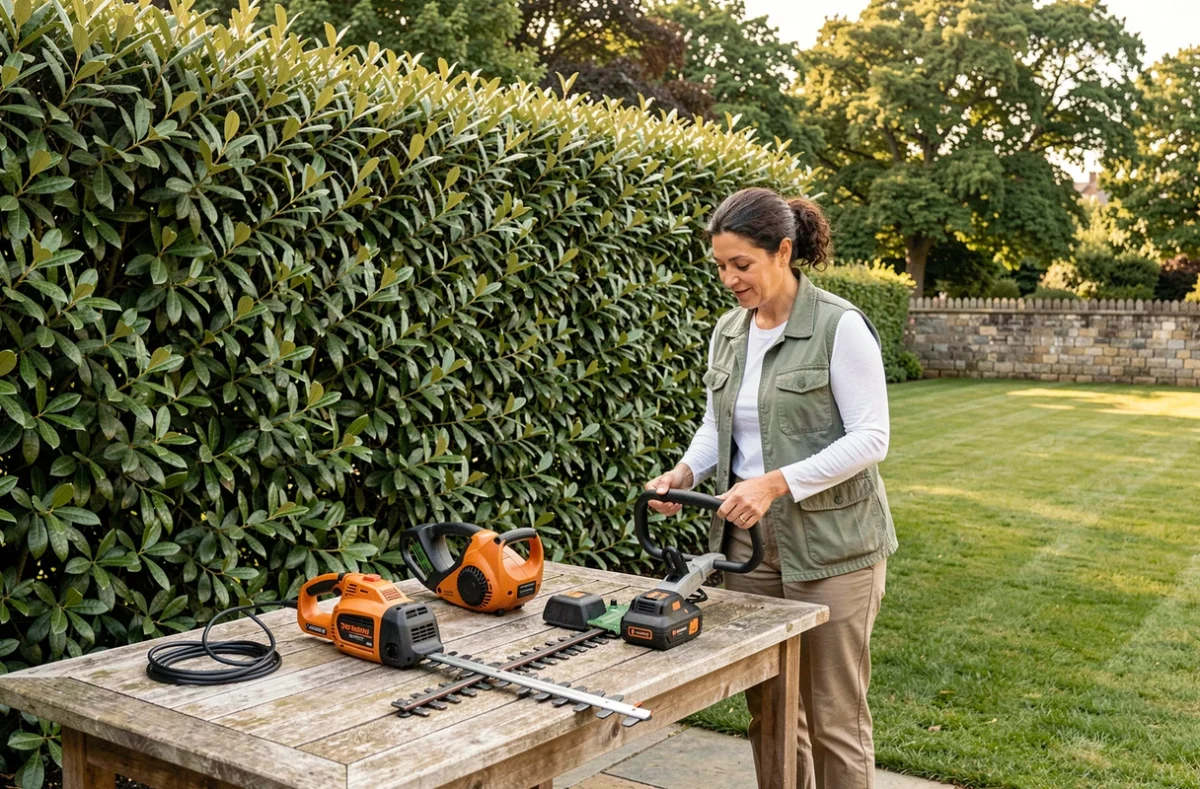
Hedge trimmer blade length: adapting the cut to the hedge
The blade length directly influences work speed and maneuverability. A short blade (around 40 to 50 cm) offers more precision for low hedges or sculpted shapes. A long blade (60 cm and beyond) covers more surface area with each pass and is suitable for linear boundary hedges.
A long blade on a narrow hedge makes the cut less precise and increases the risk of deeply cutting into healthy branches. Conversely, trimming a hedge several dozen meters long with a short blade multiplies the passes and fatigue.
Single blade or double action blade
On a single-action hedge trimmer, one blade moves while the other remains fixed. This system vibrates more. On a double-action model, both blades slide in opposite directions. Vibrations are reduced, and the cut is cleaner.
The double action significantly reduces fatigue during long trimming sessions. For regular use on dense hedges, this is a criterion not to be sacrificed for the sake of price.
Gas, battery, or corded hedge trimmer: what the terrain dictates
The choice of motorization depends less on personal preference than on measurable physical constraints: the distance to the electrical outlet, the total length of the hedge, and the density of the wood to be cut.
- The corded electric hedge trimmer remains the lightest and cheapest. Its power generally ranges between 400 and 800 W, sufficient for regular maintenance. However, the cable constraint limits its range to a few dozen meters from an outlet.
- The battery hedge trimmer offers complete freedom of movement. The actual autonomy depends on the battery voltage and the density of the hedge. Higher voltage models are suitable for dense hedges, while an entry-level battery is sufficient for thin and short hedges.
- The gas hedge trimmer delivers the highest power and operates without time limits. Its weight, noise, and emissions reserve it for large linear hedges or old hedges with thick wood.
A rarely mentioned point: the operating hours for gardening tools are set by prefectural decree and vary from one department to another. The allowed time slots on weekends and public holidays are often more restricted. Before investing in a gas model, check the permitted time slots in your municipality to avoid neighborhood conflicts.
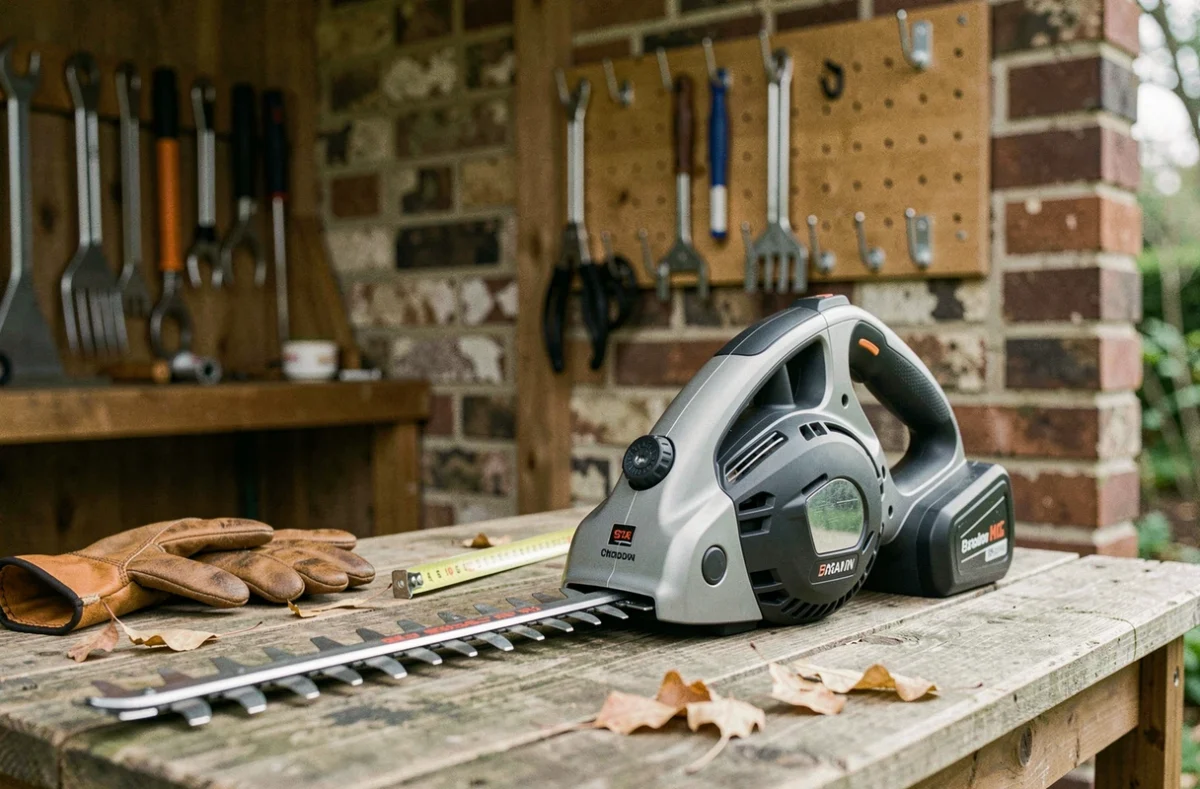
Weight, ergonomics, and safety of the hedge trimmer
The hedge trimmer is held at arm’s length, often at height and for several dozen minutes. The weight of the machine has a direct effect on the quality of the result: a tired operator cuts less straight and relaxes their vigilance.
Beyond the gross weight, the distribution of mass matters just as much. A well-balanced model, with an adjustable rear handle, is easier to maneuver in a vertical position to trim the sides of the hedge. Some manufacturers offer a pivoting handle that limits wrist twisting.
Safety equipment to check
The blade brake, which stops the blade movement in a fraction of a second after releasing the trigger, is a minimum. A protective guard at the end of the blade protects against accidental contact with a wall or fence.
Wearing cut-resistant gloves, safety glasses, and hearing protection (especially with a gas model) completes safety. These items are not always included in the box.
Trimming period and regulatory constraints
The French Office for Biodiversity recommends avoiding hedge trimming from March 15 to July 31, the nesting period for birds. For an individual, this recommendation is not an automatic national prohibition. However, destroying a nest or eggs of protected species remains prohibited year-round, regardless of the date of intervention.
In Île-de-France, proposed departmental decrees presented in 2026 foresee periods of prohibition and replanting coefficients as part of the unique hedge regime. This system concerns the management and destruction of hedges, not just regular maintenance, but it illustrates the importance of checking with your town hall before major work.
Inspecting the hedge before each trimming session, even outside the sensitive period, allows for spotting an active nest or the presence of small mammals. A delay of a few weeks is often enough to avoid any problems.
The right hedge trimmer is the one that matches the actual diameter of your branches, the length of your hedge, and your usage conditions. Checking these three parameters before purchase avoids most disappointments, much more reliably than comparing technical sheets online.