Some gardeners fear the speed at which Japanese horsetail spreads, while others exploit its growth to structure difficult spaces. This plant, often labeled as invasive, proves to be valuable when managed with rigor.
Regular maintenance, far from limiting its potential, allows for dense and healthy vegetation while avoiding uncontrolled overflow. Adopting precise and suitable actions remains the key to enhancing its ornamental and ecological qualities.
Discovering Japanese horsetail: an amazing plant that’s easy to integrate into the garden
Japanese horsetail, or equisetum japonicum, intrigues with its minimalist appearance as much as its resilience. Native to East Asia, this semi-aquatic perennial boasts numerous advantages: graphic, easily recognizable with its segmented stems dotted with black nodes, it grows where others would fail. Its vigorous growth is attributed to the strength of its rhizomes and its ability to produce spores, which explains its sometimes invasive reputation.
Installing Japanese horsetail can be considered both at the edge of a pond, on a cool bank, or in a pot or on a mineral space. Its incredible robustness, able to withstand temperatures as low as -15°C, and its general resilience make it a reliable plant, even in neglected corners. Additionally, it can also be found with herbalists and in certain phytotherapy traditions, showcasing its versatility.
Rich in silica, calcium, flavonoids, and saponins, Japanese horsetail acts as a true ecological sentinel. It reveals the nature of the soil—moist, acidic, low in silicon—and contributes to the overall balance of the garden. Its presence is never trivial: it indicates a particular ecosystem while providing a unique decor with its characteristic verticality.
To appreciate its aesthetics without risking uncontrolled proliferation, it is essential to choose the right method to prune Japanese horsetails. Detailing each step and taking cues from the expert advice available online allows for maintaining control over the clump while fully benefiting from its advantages.
What actions to take for successful pruning and optimal maintenance?
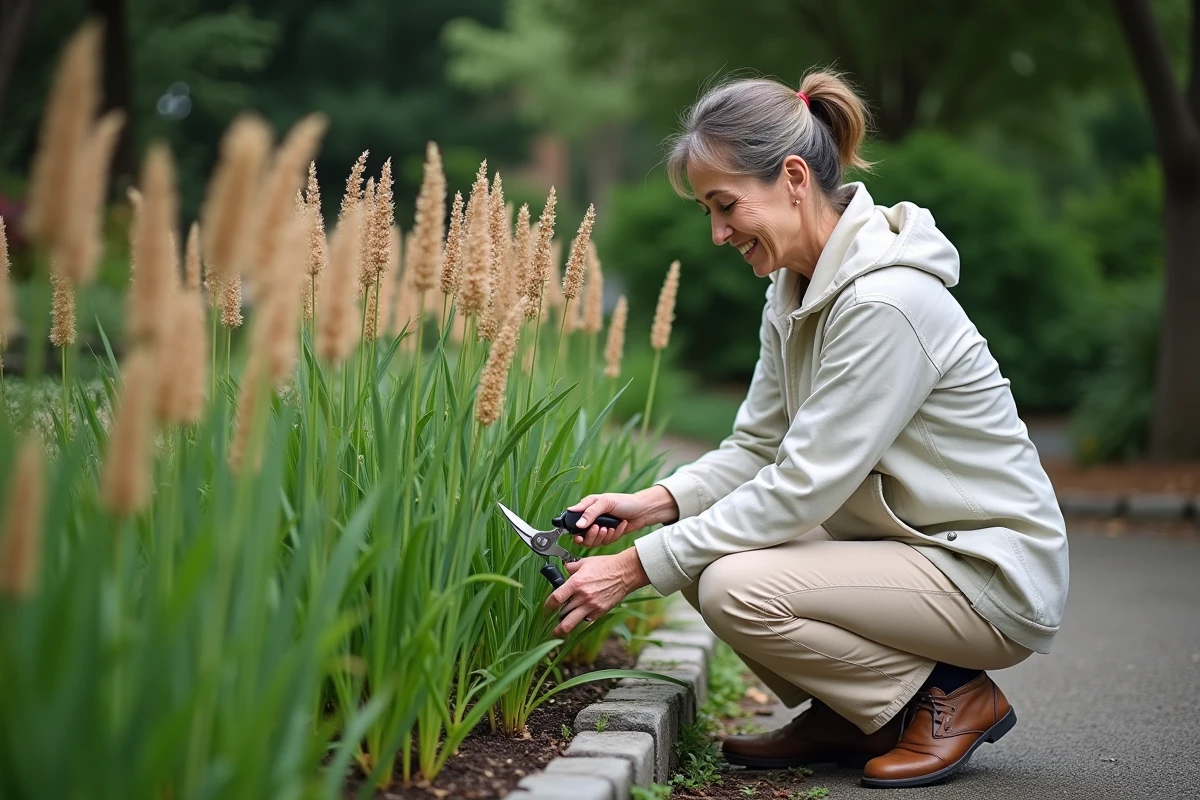
There’s no mystery to successfully maintaining Japanese horsetail: it involves acting with regularity and precision. By equipping oneself with a clean and well-sharpened pruner, one can effectively eliminate dry or damaged stems at the base. This cut encourages the emergence of vigorous new shoots and preserves the harmony of the clump.
The right time: prioritize early spring just before the vegetation resumes, or, if necessary, a late summer pruning when the clump becomes too dense. It is better not to cut more than two-thirds of the plant to avoid weakening the rhizome and ensure regrowth in the following cycle.
To limit the spread of rhizomes in the ground, installing an anti-rhizome barrier remains a serious solution. When grown in a pot, Japanese horsetail requires renewing the substrate every two years to compensate for the vigor of its roots and providing ample water, especially during dry spells. The appearance of stems outside the designated area signals the need to act quickly to maintain control of the space.
In addition to framing its development, regular pruning densifies the foliage, simplifies associations with other perennials suited to humidity, and limits the dispersion of spores. The remains from the cuts can then be used directly as mulch or added to the compost, providing nitrogen, minerals, and silica to the garden.
Unexpected benefits for your garden and the environment
Japanese horsetail does not just structure space: it transforms the soil deeply and enriches the plant palette. Its sustained growth and upright, vibrant green stems mark the scene, while its pruning residues can easily be used as mulch, thanks to their richness in silica and potassium. The result: stimulated organic matter, nourished microorganisms, and aerated, strengthened soil.
On the protection side, horsetail manure acts as a natural shield against scab, downy mildew, or rust. Sprayed on leaves, it helps neighboring plants better resist cryptogamic diseases. Its effect is not limited to the surface: by stabilizing banks, Japanese horsetail prevents leaching in sandy areas, assists in the natural filtration of water, and becomes an ally for gardens by ponds where biodiversity flourishes.
Creating a harmonious bed around horsetail opens up numerous possibilities. Here are some examples of useful or decorative associations:
- Papyrus and sedges to emphasize verticality
- Marsh iris, cotton grass, to introduce subtle contrasts
- Ferns and hostas to enrich the shaded corners of the garden
Beyond the beaten paths of traditional gardening, Japanese horsetail is gaining ground in plant design, making its way into natural cosmetics and even eco-construction initiatives. As for permaculture, it relies on its ability to remineralize the soil or support its balance, season after season.
Handled intelligently, Japanese horsetail is no longer an unmanageable invader but becomes a centerpiece with multiple facets. Behind these straight stems, a whole biodiversity finds its anchor point, and the garden gradually takes shape in its image, with boldness and relief.